
CGST vs SGST vs IGST: Difference, Examples & When to Charge (2026)
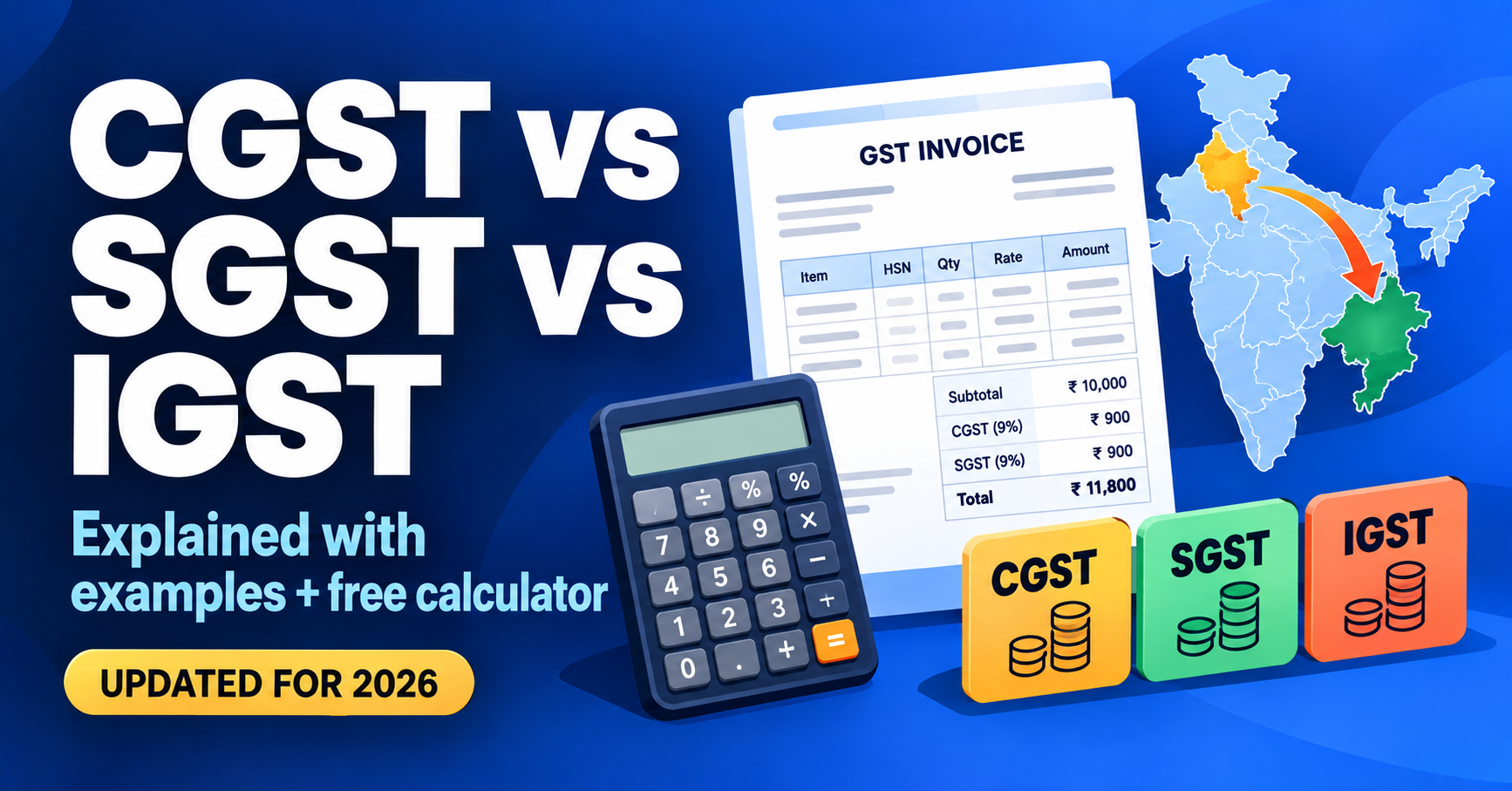
If you issue GST invoices, you have to decide on every bill whether to charge CGST and SGST or IGST. Get it wrong and your customer cannot claim input tax credit properly. This guide explains CGST, SGST and IGST in plain language, gives you a simple rule for when to charge each, shows worked examples and sample GST invoices, and includes a free GST calculator and a "which tax applies?" finder. It is updated for the 2026 GST rates. Last reviewed: 31 October 2026.
What are CGST, SGST and IGST?
India collects GST in three parts, depending on where a sale takes place:
Central GST
The share of GST that goes to the Central Government. It is charged on sales inside one state.
State GST
The share that goes to the State Government. It is charged together with CGST on sales inside one state.
Integrated GST
One single tax charged on sales between two states (or imports and exports). The Centre collects it and shares it with the state where the goods or services are consumed.
In a union territory without its own legislature (such as Chandigarh or Ladakh), SGST is replaced by UTGST.
The simple rule: when to charge CGST + SGST and when to charge IGST
The total tax is the same in all cases. Only the way it is split and reported changes. For most everyday sales, the "place of supply" is the customer's location, but the rules differ for some services and special cases, so check with your accountant when in doubt.
CGST vs SGST vs IGST: the difference at a glance
| Point | CGST | SGST / UTGST | IGST |
|---|---|---|---|
| Full form | Central Goods and Services Tax | State (or Union Territory) Goods and Services Tax | Integrated Goods and Services Tax |
| Charged on | Sales within a state | Sales within a state | Sales between states, imports and exports |
| Rate on an 18% item | 9% | 9% | 18% |
| Goes to | Central Government | State Government | Centre, then shared with the destination state |
| Always charged with | SGST or UTGST | CGST | Alone (never with CGST or SGST) |
GST rates in 2026: 5%, 18% and 40%
GST was simplified from 22 September 2025 after the 56th GST Council meeting. The older 12% and 28% slabs were removed, and most goods and services moved to simpler rates:
| GST rate | CGST | SGST | IGST | Typically applies to |
|---|---|---|---|---|
| 0% | 0% | 0% | 0% | Exempt items such as certain basic food and essential services |
| 5% | 2.5% | 2.5% | 5% | Many everyday goods and some services |
| 18% | 9% | 9% | 18% | Most goods and services, including a lot of professional and IT services |
| 40% | 20% | 20% | 40% | A small list of luxury and "sin" goods |
A few items carry special rates (for example, gold and precious jewellery are reported at 3%). The exact rate for your product or service depends on its HSN or SAC code, so always check the latest CBIC notifications or ask your accountant.
Free GST calculator: split CGST, SGST and IGST
Enter an amount and a rate to see the tax split for your kind of sale. You can add GST to a price, or work backwards from a price that already includes GST.
GST calculator
Turn this into a GST invoice (free) →
Which tax applies to my sale? Try the finder
Pick the state you sell from and the state you sell to. This assumes the place of supply is the customer's state, which is the usual case for business sales of goods.
CGST / SGST / IGST finder
Examples with calculations
Example 1: Sale within the same state (CGST + SGST)
A consultant in Kolkata bills a client in Kolkata ₹50,000 for services at 18% GST.
| Item | Amount |
|---|---|
| Taxable value | ₹50,000 |
| CGST @ 9% | ₹4,500 |
| SGST @ 9% | ₹4,500 |
| Invoice total | ₹59,000 |
Example 2: Sale to another state (IGST)
The same Kolkata consultant bills a client in Mumbai for the same ₹50,000 service.
| Item | Amount |
|---|---|
| Taxable value | ₹50,000 |
| IGST @ 18% | ₹9,000 |
| Invoice total | ₹59,000 |
The total is the same as in Example 1. Only the tax heading changes.
Example 3: Goods at 5%
A shop in Siliguri sells goods worth ₹20,000 at 5% GST to a buyer in the same state: CGST 2.5% = ₹500, SGST 2.5% = ₹500, total ₹21,000. If the buyer was in another state, you would charge IGST 5% = ₹1,000, and the total would still be ₹21,000.
Example 4: Union territory (UTGST)
A supplier in Chandigarh sells goods worth ₹10,000 at 18% to a customer in Chandigarh: CGST 9% = ₹900 and UTGST 9% = ₹900, total ₹11,800. If the customer is in Punjab, it is IGST 18% = ₹1,800.
Example 5: Export
Exports are treated as inter-state supplies and are "zero-rated". Exporters generally either export under a Letter of Undertaking (LUT) without paying IGST, or pay IGST and claim a refund. The rules and paperwork are detailed, so speak to a chartered accountant.
How CGST, SGST and IGST appear on a GST invoice
A proper GST tax invoice shows the tax split clearly, with each tax in its own line and the rate beside it. For a same-state sale, it shows two lines (CGST and SGST). For an inter-state sale, it shows one line (IGST). Other essentials include your GSTIN, the invoice number and date, the customer's details, HSN or SAC codes, the taxable value and the place of supply. Our guide on what to include in an invoice covers the full list.
You do not have to type all this by hand. Our free invoice generator lets you choose "GST: same state (CGST + SGST)" or "GST: different state (IGST)", add the HSN or SAC code and rate for each item, and it calculates the tax for every rate and downloads a clean PDF. No signup, and nothing is uploaded.
Input tax credit: how the three taxes are used
Businesses can generally set off the GST they paid on purchases (input tax credit) against the GST they owe on sales. In general terms, IGST credit is used first against IGST, then against CGST and SGST. CGST credit is used against CGST and then IGST, and SGST credit against SGST and then IGST. CGST credit cannot be used against SGST, and SGST credit cannot be used against CGST. Credit rules have conditions, so confirm the details for your business with your accountant.
Common mistakes to avoid
Charging IGST on a same-state sale
Use CGST + SGST when the supplier and the place of supply are in the same state.
Charging both CGST and IGST
IGST is charged alone. It never appears together with CGST or SGST on the same item.
Splitting the rate wrongly
For CGST and SGST, each is half of the rate. A 5% item has 2.5% + 2.5%, not 5% + 5%.
Using an old rate
The 12% and 28% slabs were removed in 2025. Check the current rate for your HSN or SAC code.
Ignoring the place of supply
For some services, the place of supply is not the customer's address. Check the rule for your service.
Missing details on the invoice
No GSTIN, HSN or place of supply can create problems for you and your customer.
Frequently asked questions
What is the difference between CGST, SGST and IGST?
CGST goes to the Central Government and SGST goes to the State Government, and both are charged on sales within one state. IGST is a single tax charged on sales between states, collected by the Centre and shared with the destination state.
When should I charge IGST instead of CGST and SGST?
Charge IGST when the supplier and the place of supply are in different states or union territories, and on imports and exports. Charge CGST and SGST when both are in the same state.
How much is CGST and SGST on an 18% GST rate?
Each is 9%. CGST 9% plus SGST 9% makes 18%. For an inter-state sale, IGST is the full 18%.
What is UTGST?
UTGST is the tax charged in place of SGST in union territories without their own legislature, such as Chandigarh and Ladakh. It is charged together with CGST.
Can I charge CGST, SGST and IGST on the same invoice?
On a single item, no. You charge either CGST plus SGST, or IGST. An invoice with several items could mix them only if the items have different places of supply, which is rare.
What are the GST rates in 2026?
The main GST rates are 0%, 5%, 18% and 40%, after the 12% and 28% slabs were removed in September 2025. A few goods carry special rates. Check the latest notifications for your specific item.
How do I calculate GST on a price that already includes GST?
Divide the price by (1 + rate). For example, ₹11,800 with 18% GST: ₹11,800 ÷ 1.18 = ₹10,000, so the GST is ₹1,800. The calculator above does this for you.
Is the total GST the same for same-state and inter-state sales?
Yes. The total tax is the same. It is only split differently (CGST + SGST versus IGST).
Do small businesses need to charge GST?
Only registered businesses charge GST. Registration is required once your turnover crosses the limit, or in certain cases regardless of turnover. See our GST registration guide.
Where can I make a GST invoice for free?
You can use our free invoice generator, which supports CGST + SGST and IGST, HSN or SAC codes and PDF download with no signup.
Make your GST invoice in two minutes
Pick CGST + SGST or IGST, add your items and download a clean PDF. Free, no signup, nothing uploaded.
Use the free invoice generator →Need help with GST registration or billing? Talk to our team.
This article is general information, not tax or legal advice. GST rates, rules and place-of-supply provisions change and have exceptions, so confirm the details with the official GST portal, CBIC notifications or a chartered accountant before you rely on them for your business.
Comments
No comments yet. Be the first to share your thoughts.
Leave a Comment
Related Posts

Common Mistakes That Get Government Applications Rejected
Name mismatches, blurry documents, wrong file sizes: see the most common reasons government applications are rejected, with fixes and a checklist.
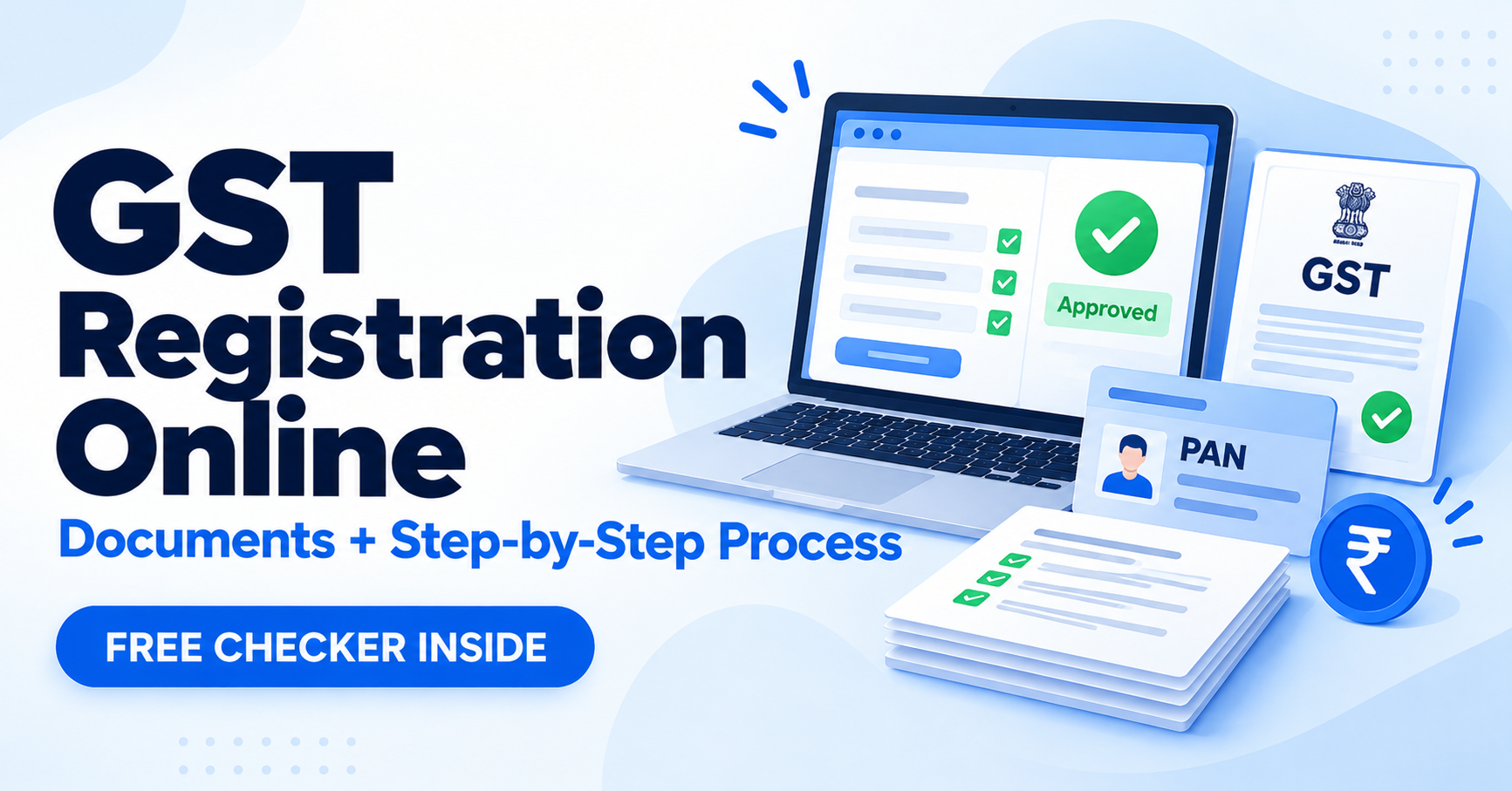
How to Get a GST Registration Online: Documents and Process
Need a system like this for your business?
Tell us what you're working with today and we'll show you what a custom system could look like — no obligation.