
New PF Rules 2026: EPF Wage Ceiling Raised to ₹25,000 (Old vs New Calculation)
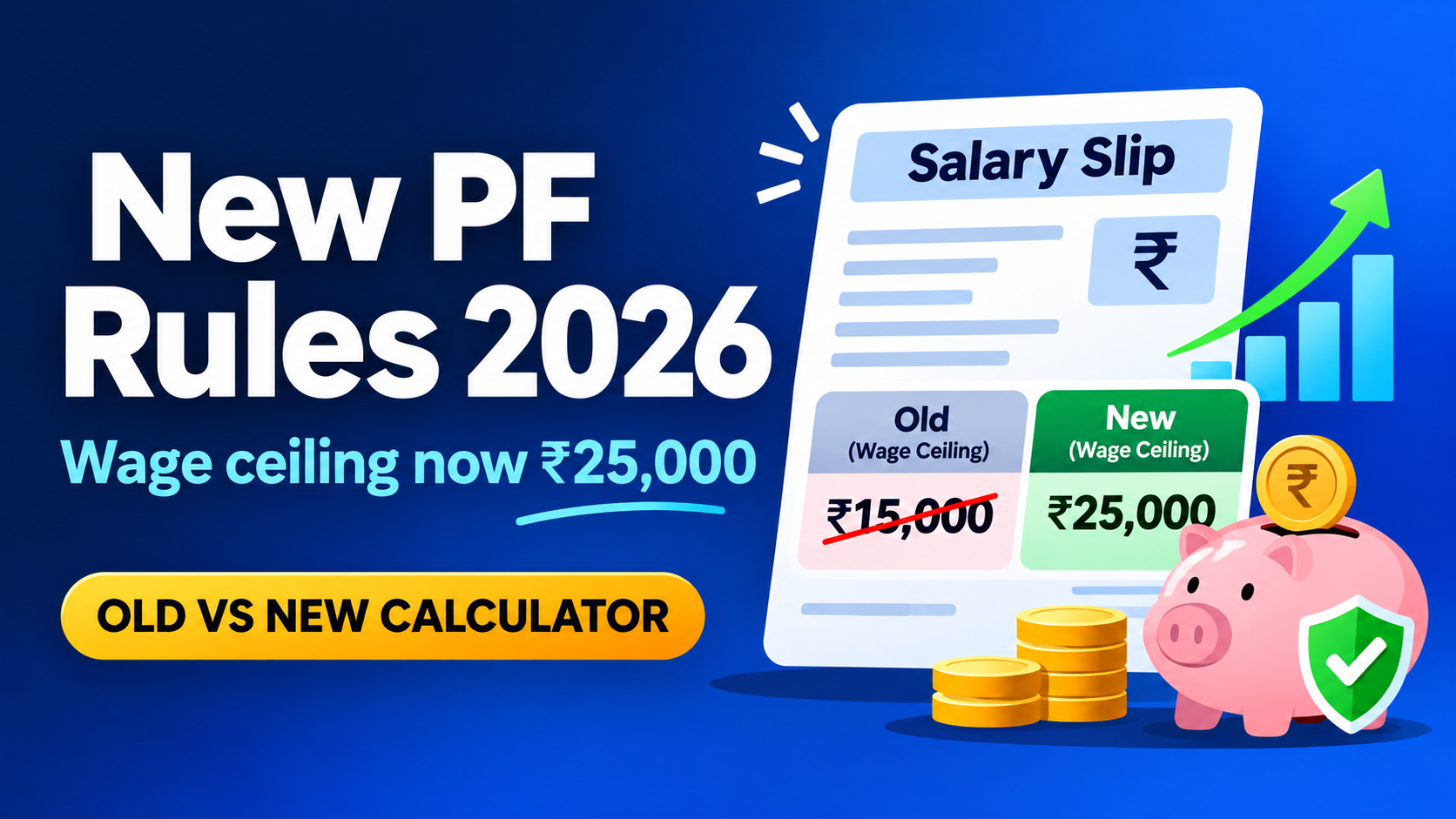
From 17 September 2026, the wage ceiling for the Employees' Provident Fund (EPF) has gone up from ₹15,000 to ₹25,000 a month, the first revision in over a decade. If you earn a basic salary and DA of more than ₹15,000, your PF deduction, your employer's contribution, your pension and your take-home pay can all change. This guide explains what has changed in the PF rules, who is affected, how the old and new calculations differ, and what to do now. Use the free Old vs New PF Calculator to see your own numbers. Last reviewed: 31 October 2026.
PF rule changes at a glance
Before 17 September 2026
Wage ceiling for mandatory EPF, EPS and EDLI coverage.
Maximum employee PF: ₹1,800 a month.
Maximum pensionable salary: ₹15,000.
From 17 September 2026
New ceiling for mandatory EPF, EPS and EDLI coverage.
Maximum employee PF: ₹3,000 a month.
Maximum pensionable salary: ₹25,000.
| What changed | Before | Now | Status |
|---|---|---|---|
| Wage ceiling (EPF, EPS, EDLI) | ₹15,000 a month | ₹25,000 a month | Notified |
| Maximum employee contribution (12%) | ₹1,800 | ₹3,000 | Notified |
| Maximum employer EPS share (8.33%) | ₹1,250 | ₹2,083 | Notified |
| Employees earning ₹15,001 to ₹25,000 | Not compulsory members | Compulsory members of EPF, EPS and EDLI | Notified |
| Employees earning above ₹25,000 | Optional | Still optional (employer consent) | Notified |
| Meaning of "wages" for PF | Older definition | Code on Wages style definition, including the 50% rule | From Nov 2025 |
| Partial withdrawal rules | 13 separate provisions | 3 simplified categories, 12 months of service | Approved, check effective date |
| Interest rate for 2025-26 | 8.25% (2024-25) | 8.25% | Confirmed |
What exactly changed? The key facts
- Notification: The Ministry of Labour and Employment raised the ceiling through Gazette notification S.O. 5109(E) dated 17 September 2026, effective the same day. The Union Labour Minister announced it on 16 September 2026.
- Who it covers: About 51 lakh additional workers, with EPF wages between ₹15,001 and ₹25,000, are brought into mandatory coverage under EPF, EPS and EDLI.
- Above ₹25,000: Employees whose EPF wages are above ₹25,000 are not required to be covered, but they can join voluntarily with the employer's consent. Members who already contribute on a higher amount are not forced to reduce it.
- Rates did not change: The contribution rate is still 12% from the employee and 12% from the employer. Only the ceiling on which it is calculated has gone up.
- It is measured on EPF wages, not gross pay: The ceiling is tested against "EPF wages" (basic pay, dearness allowance and similar items as defined in the Code on Social Security, 2020), not your total CTC or gross salary. An employee with ₹50,000 gross and ₹25,000 of EPF wages would be covered.
- No application needed: Enrolment of newly covered employees is the employer's responsibility. Existing balances, your UAN and your service history continue.
Timeline of recent PF changes
Who is affected by the new PF ceiling?
| Your EPF wages (basic + DA) | What changes for you |
|---|---|
| Up to ₹15,000 | No change. You were already covered, and the contribution is 12% of your actual wages. |
| ₹15,001 to ₹25,000 | You become a compulsory member of EPF, EPS and EDLI, or your contribution rises, because it is now calculated on your actual wages up to ₹25,000. Your employee share goes up and your take-home goes down. Your PF and pension grow. |
| Above ₹25,000, contributing on ₹15,000 so far | Your mandatory contribution base is now ₹25,000, so your deduction can rise by up to ₹1,200 a month. Check what your employer applies. |
| Above ₹25,000, already contributing on higher wages | Existing higher-wage arrangements are not automatically reduced. |
| Employers | Higher contributions for covered employees, new enrolments and a September 2026 return to get right. |
How PF is calculated: the old method vs the new method
The formula itself did not change. Only the ceiling did. Here is how a month's PF is built:
- Find your EPF wage: basic pay plus dearness allowance (and similar items), as defined in the law.
- Apply the ceiling: use your actual EPF wage, or the ceiling if you earn more (₹15,000 before, ₹25,000 now).
- Employee share: 12% of that amount, deducted from your salary.
- Employer share: also 12%, split into 8.33% to the Pension Scheme (EPS) and the rest, 3.67%, to your EPF account.
- Other employer charges: 0.5% for EDLI (insurance) and 0.5% for administration. These do not go into your account.
Worked examples: old vs new
These examples are for an existing member contributing on the old ceiling.
| EPF wage | Employee PF (before) | Employee PF (now) | Your take-home change | Employer EPS now | Employer EPF now |
|---|---|---|---|---|---|
| ₹10,000 | ₹1,200 | ₹1,200 | No change | ₹833 | ₹367 |
| ₹15,000 | ₹1,800 | ₹1,800 | No change | ₹1,250 | ₹550 |
| ₹20,000 | ₹1,800 | ₹2,400 | − ₹600 | ₹1,666 | ₹734 |
| ₹25,000 | ₹1,800 | ₹3,000 | − ₹1,200 | ₹2,083 | ₹917 |
| ₹35,000 | ₹1,800 | ₹3,000 | − ₹1,200 | ₹2,083 | ₹917 |
Employer cost at the ceiling: the employer's total contribution, with EDLI and admin charges (13% in all), rises from about ₹1,950 to about ₹3,250 per month per covered employee.
Free Old vs New PF Calculator
Enter your basic pay plus DA to compare your PF before and after the change, see your take-home impact, and see a rough projection of your PF balance and your pension. The projections are illustrations, not official figures.
Old vs New PF calculator
September 2026: how was the transition month calculated?
Because the ceiling changed on 17 September, employers asked how to calculate PF for that month. EPFO's FAQs describe a two-period method: the old ceiling for 1 to 16 September and the new ceiling for 17 to 30 September. Some law firms argue that the full ₹25,000 can be used for continuing members. The position was described as open to interpretation, and no single official operating formula was confirmed in the sources we reviewed. The combined return for September was due by 15 October 2026. This tool shows both methods.
September 2026 transition calculator
Is your take-home salary going down?
Yes, if your EPF wage is above ₹15,000. Your employee share rises up to ₹1,200 a month at ₹25,000. Employers were allowed to defer recovering the employee share to the next payroll cycle without prior approval, but the return and the full payment were still due. The money is not lost: it goes into your PF and pension. Over a long career, a higher contribution can add a lot to your retirement savings, as the calculator above shows.
The 50% wage rule and your PF
Since the labour codes came into force on 21 November 2025, "wages" are defined so that basic pay, dearness allowance and retaining allowance should generally make up at least 50% of your total pay. If certain allowances exceed 50%, the excess is counted as wages. This raises the base on which PF is calculated, and many employers restructured salaries. Because the PF ceiling is now ₹25,000, the effect is limited for higher earners, but it can matter for people whose basic is below ₹25,000. Ask your HR how your salary is structured.
| Gross salary | Basic share | Basic + DA | PF base (ceiling ₹25,000) | Employee PF |
|---|---|---|---|---|
| ₹40,000 | 30% | ₹12,000 | ₹12,000 | ₹1,440 |
| ₹40,000 | 50% | ₹20,000 | ₹20,000 | ₹2,400 |
| ₹60,000 | 30% | ₹18,000 | ₹18,000 | ₹2,160 |
| ₹60,000 | 50% | ₹30,000 | ₹25,000 | ₹3,000 |
The same gross salary can give a very different PF deduction depending on how much of it is basic pay.
EPS pension: what changes
- The maximum pensionable salary rises from ₹15,000 to ₹25,000, so the employer's EPS share can go up to ₹2,083 a month.
- The pension formula is generally the pensionable salary multiplied by pensionable service, divided by 70.
- Employees earning ₹15,001 to ₹25,000 who were not in EPS are enrolled automatically from 17 September 2026. EPS membership is available only if wages at joining, or on the date the new ceiling took effect, do not exceed ₹25,000.
- A higher pension is possible for eligible members, but it is not automatic. It depends on your service and wages over time.
- The government's own contribution to EPS remains capped at 1.16% of wages up to ₹15,000.
New PF withdrawal rules (approved by EPFO)
Separately from the ceiling, EPFO's board approved simpler withdrawal rules in October 2025. Reports say these include the following. Check the effective date on the EPFO portal, as some points depend on formal notification.
| Point | Earlier | New rule (reported) |
|---|---|---|
| Partial withdrawal categories | 13 separate provisions | 3 categories: essential needs, housing and special circumstances |
| Minimum service for partial withdrawal | Varied by purpose | 12 months for all categories |
| Marriage and education | 3 withdrawals in total | Education up to 10 times, marriage up to 5 times |
| Amount you can withdraw while working | Lower, varied limits | Reported to be up to 75% of the balance, with 25% kept in the account |
| Pension (EPS) withdrawal after leaving a job | After 2 months | Reported to be after 36 months |
Reports on the final-settlement waiting period and the 25% rule are not fully consistent, so confirm them on the EPFO member portal before you plan a withdrawal.
PF interest rate
EPFO's board fixed the interest rate for 2025-26 at 8.25%, the third year in a row, and the government ratified it in June 2026. Interest is calculated monthly on the running balance and credited annually. A higher contribution base means your balance, and therefore your interest, grows faster.
What should you do now? Checklist
Tick what you have checked. Your progress is saved in this browser.
0 of 10 done
What employers and small businesses need to do
Enrol newly covered staff
Employees with EPF wages of ₹15,001 to ₹25,000 must be enrolled in EPF, EPS and EDLI from 17 September 2026.
Update payroll
Recalculate contributions on the new ceiling and decide how September 2026 is handled.
File on time
File the monthly return (ECR) and pay by the 15th of the next month to avoid interest and damages.
Tell your team
Explain the change and the take-home impact before the payslip shows it.
Budget the cost
The employer's cost per covered employee rises. Plan for it in your hiring and pricing.
Check registration
New businesses with the required number of employees need an EPFO registration. See our business setup checklist.
Official links
Frequently asked questions
What is the new PF wage ceiling?
The ceiling for mandatory EPF, EPS and EDLI coverage is ₹25,000 per month from 17 September 2026. It was ₹15,000 before.
Has the PF contribution rate changed?
No. The rate is still 12% from the employee and 12% from the employer. Only the ceiling on which it is calculated has changed.
Will my salary decrease because of the new PF rules?
Your take-home pay can fall if your EPF wage (basic + DA) is above ₹15,000, because your 12% share is now calculated on up to ₹25,000. The maximum rise in your deduction is ₹1,200 a month. The money goes into your PF and pension.
Is the PF wage ceiling based on my gross salary or my basic pay?
It is based on EPF wages, which are basic pay, dearness allowance and similar items as defined by law, not your gross salary or CTC.
I earn more than ₹25,000. Do I have to contribute on my full salary?
No. Contribution above the ceiling is voluntary and needs employer consent. Existing higher-wage arrangements are not automatically reduced.
How is September 2026 PF calculated?
EPFO's FAQs describe two periods, with the old ceiling for 1 to 16 September and the new one for 17 to 30 September. Some experts suggest using the full ₹25,000 for continuing members. The method was described as open to interpretation, so ask your employer or CA.
Will my pension increase?
The maximum pensionable salary has risen to ₹25,000, so eligible members can build a higher pension over time. It depends on your wages and years of service, and it is not automatic.
Do I need to apply to be covered under the new ceiling?
No. Enrolment is your employer's responsibility, and your UAN, balance and service history continue as before.
What is the EPF interest rate for 2025-26?
8.25%, the same as the previous year.
Are the new PF withdrawal rules in effect?
EPFO's board approved simpler withdrawal rules in October 2025. Some parts depend on formal notification and reports differ on the details, so check the EPFO portal before you withdraw.
What is the 50% wage rule?
Under the new labour codes, basic pay, DA and retaining allowance should generally form at least half of your total pay for PF and gratuity purposes. If allowances exceed 50%, the excess is counted as wages.
Where can I check my PF balance?
On the EPFO member portal using your UAN, or through the UMANG app and the EPFO missed-call service.
Running a business? Get your PF and registrations right
We can help you with business registrations, documents and compliance setup, so you can focus on your work.
Talk to our team →Also read: GST registration guide and Udyam registration.
This article is general information, not legal, tax or financial advice. PF and labour rules are changing and details in notifications and circulars may differ from what is reported. The calculators show illustrations based on the rules and assumptions described above, and are not official EPFO calculations. Always confirm with the latest EPFO notifications, your employer or a qualified professional.
Comments
No comments yet. Be the first to share your thoughts.
Leave a Comment
Related Posts

How to Withdraw PF Online in 2026: Step-by-Step Guide with the New Rules
Step-by-step guide to withdraw your EPF online in 2026: KYC checklist, claim forms 19, 31 and 10C, reported new rules, TDS, and a free withdrawal estimator.
Need a system like this for your business?
Tell us what you're working with today and we'll show you what a custom system could look like — no obligation.